Calm Breathing for Busy Minds: A Simple Routine for Daily Use
Category: Stress & Mental Wellness
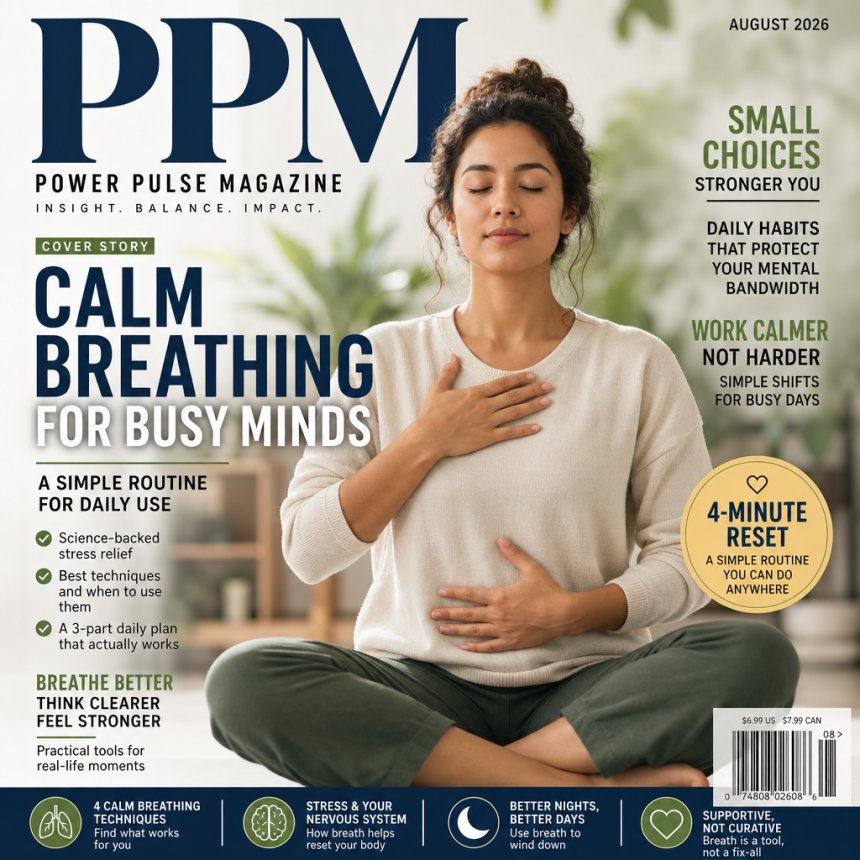
Calm Breathing for Busy Minds: A Simple Routine for Daily Use
Breathing for Calm: Simple Techniques and When They Work Best
Writer: PPM Editorial Team
When your mind is busy, your breathing often changes before you even notice it. It becomes faster, shallower, and more chest-focused. That shift is more than a habit — it can keep the body in a stress-ready state.
The good news is that the reverse is also true: breathing can be used as a reset tool.
Calm breathing will not fix a difficult job, erase anxiety, or replace therapy when it is needed. But it is one of the simplest ways to influence how stressed your body feels in the moment. It takes no equipment, can be done almost anywhere, and works best when practiced consistently.
Why breathing affects stress
Breathing is one of the few body functions that is both automatic and under voluntary control. That makes it uniquely useful for stress regulation.
When stress rises, the nervous system tends to shift into a more alert state:
- breathing speeds up
- muscles tighten
- heart rate may rise
- the body becomes more reactive
Slow, controlled breathing can help signal safety back to the body. Research suggests that paced breathing, especially when the exhale is longer than the inhale, can increase parasympathetic activity, improve heart rate variability, and reduce feelings of stress and anxiety.
What the science says
- Slow breathing around 5–6 breaths per minute is often associated with improved autonomic balance and higher heart rate variability in many people.
- Diaphragmatic breathing and paced breathing have shown modest benefits for stress reduction, anxiety, and sometimes blood pressure in clinical studies.
- Breathing practices are most effective as part of a broader wellness routine, not as a stand-alone cure.
What people may not know:
You do not need to breathe “deeper” in a dramatic way to calm down. In fact, over-breathing can make some people feel lightheaded or more anxious. The goal is usually slower and smoother, not bigger.
The simplest daily routine: 4 minutes
If you want one routine that is easy to remember and easy to repeat, try this:
The 4-minute calm breathing reset
1. Settle for 20 seconds
Sit or stand comfortably. Relax your jaw, drop your shoulders, and soften your hands.
2. Breathe in for 4 seconds
Use your nose if comfortable. Keep the breath gentle.
3. Breathe out for 6 seconds
Let the exhale be a little longer than the inhale. Do not force it.
4. Repeat for 3–4 minutes
Aim for a smooth rhythm, not perfection.
Why this works
A slightly longer exhale can help nudge the body toward a calmer state. Many people find this easier than trying to “breathe deeply,” which can sometimes feel awkward or overstimulating.
Best calm breathing techniques and when to use them
1. Paced breathing
Best for: daytime stress, quick resets, pre-meeting nerves, work breaks
This is the most practical all-purpose method. You breathe at a steady pace, often around 5–6 breaths per minute, with the exhale equal to or slightly longer than the inhale.
Try:
- Inhale 4 seconds
- Exhale 6 seconds
- Continue for 2–5 minutes
Why it helps:
It is one of the most consistent breathing styles studied for calming the nervous system.
2. Box breathing
Best for: focus, structure, high-pressure moments, pre-presentation calm
This technique uses equal counts:
- inhale 4
- hold 4
- exhale 4
- hold 4
It is popular because it is simple and gives the mind a clear pattern to follow.
What to be aware of:
The breath-hold portion is not ideal for everyone. If holding the breath makes you uncomfortable, switch to paced breathing instead.
What people may not know:
Box breathing is often used in high-stress professions, but it is not inherently better than other methods. It is simply easier for some people to follow.
3. Diaphragmatic breathing
Best for: people who breathe high in the chest, chronic tension, winding down after a stressful day
This technique encourages the diaphragm — the main breathing muscle — to do more of the work.
How to do it:
- Place one hand on your chest and one on your belly
- Inhale gently through the nose
- Let the belly expand slightly
- Exhale slowly and relax
Why it helps:
It can reduce accessory muscle tension in the neck and upper chest, and it may help people notice when stress has changed their breathing pattern.
What to be aware of:
Do not force the belly outward. The movement should be subtle and comfortable.
4. Extended exhale breathing
Best for: stress spikes, evening wind-down, bedtime routines
This is the easiest technique to start with if you do not want to count too much.
Try:
- Inhale 3 or 4 seconds
- Exhale 5 to 8 seconds
- Repeat for a few minutes
Why it helps:
A longer exhale tends to be soothing and can feel less mentally demanding than more structured breathing exercises.
When calm breathing works best
Breathing practices are especially useful when stress is mild to moderate, or when you want to prevent stress from escalating.
They tend to work best:
- before a meeting or presentation
- between work tasks
- after reading difficult news
- during commute transitions
- before bed
- after conflict or emotional overload
- when you notice physical tension building
When it may work less well
Breathing is not always the right first step.
It may be less useful:
- during severe panic, if focusing on breath makes symptoms worse
- in moments of intense trauma activation
- when someone is very short of breath for medical reasons
- if the technique is too complicated or uncomfortable to follow
In those cases, grounding through the senses, stepping outside, or getting support may work better.
What People may not know or learning to be aware of
Here are a few less obvious but important facts:
1. More force is not better
A common mistake is trying to take huge breaths. That can lead to over-breathing, dizziness, or a sense of air hunger. Calm breathing should feel gentle.
2. The exhale matters
Many people focus only on the inhale, but the exhale is often where the calming effect comes from.
3. You do not need to “empty” your lungs
Trying to completely force air out can create tension. A natural, relaxed exhale is enough.
4. Breathing is a skill
Like exercise, it works better when practiced regularly. A 2-minute routine every day can be more helpful than an occasional 15-minute session.
5. Breathing is supportive, not curative
It can lower stress in the moment, but it does not solve the source of chronic overload, poor sleep, trauma, or burnout.
What can help make breathing more effective
If you want this to become a real daily habit, tie it to something you already do:
- after you sit at your desk
- before opening email
- after lunch
- before driving home
- when you get into bed
Helpful tips
- Keep the counts simple
- Practice at the same time each day
- Use a timer or breathing app if needed
- Pair breathing with a physical cue, like unclenching your jaw
- Start with 1–2 minutes if 5 minutes feels too long
What helps most: consistency, not perfection.
Common mistakes to avoid
1. Breathing too deeply
This can increase lightheadedness in some people.
2. Forcing the rhythm
If you strain to count, the practice can become stressful instead of calming.
3. Expecting instant transformation
Breathing may help in the moment, but its deeper benefits come from repetition.
4. Using breathing as avoidance
It can help regulate stress, but it should not be the only response if you need to address a real problem.
5. Ignoring symptoms
If you feel chest pain, severe shortness of breath, faintness, or unusual symptoms, stop and seek medical help if needed.
A simple 3-part daily plan
If you want a practical routine, try this:
Morning: 1 minute
Use paced breathing before checking your phone.
Midday: 2 minutes
Do extended exhale breathing after a work block or lunch.
Evening: 3 minutes
Use diaphragmatic breathing or box breathing before bed.
This small structure can make breathing a reliable part of your stress-management toolkit.
The bottom line
Calm breathing is simple, but it is not simplistic. There is real science behind the idea that slower, steadier breathing can help regulate stress responses and support emotional balance.
The most useful approach is the one you can actually repeat:
- paced breathing for everyday stress
- box breathing for focus
- diaphragmatic breathing for tension and body awareness
- longer exhales for quick calm
If your day is busy, you do not need a perfect routine. You need a small one you will use.
PPM Takeaway
Calm breathing is one of the most accessible stress tools available. A few minutes of slow, steady breathing can help shift the body out of stress mode, especially when practiced regularly. The best technique depends on the moment — but the goal is the same: reduce strain, create space, and help the mind settle.
PPM Disclaimer
AI-assisted research may support the editorial process at Power Pulse Magazine (PPM). All content is reviewed, fact-checked, and edited by a human editor before publication. Creative direction, editorial oversight, and final publication decisions are made by PPM. This article is for general informational and educational purposes only and is not intended as medical advice, diagnosis, or treatment. Breathing techniques may not be suitable for everyone. If you experience panic, dizziness, chest pain, shortness of breath, or ongoing mental health concerns, please consult a qualified healthcare professional.
Share
What's Your Reaction?
 Like
0
Like
0
 Dislike
0
Dislike
0
 Love
0
Love
0
 Funny
0
Funny
0
 Angry
0
Angry
0
 Sad
0
Sad
0
 Wow
0
Wow
0