Your Body Isn’t a Productivity Machine
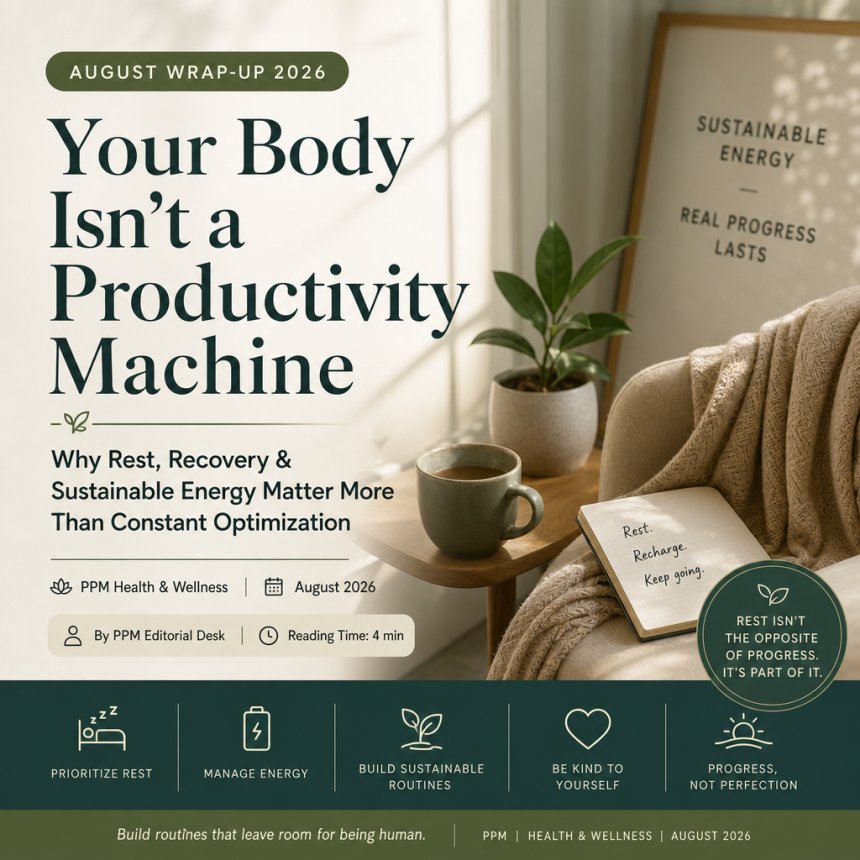
In “Your Body Isn’t a Productivity Machine,” PPM explores why constantly optimizing your time, health, and performance can leave you more exhausted—not more fulfilled. This August 2026 feature looks at the difference between productive rest and avoidance, why recovery belongs in a realistic routine, and how to recognize when your daily demands are exceeding your capacity. The article also introduces the PPM Energy Budget, a practical companion to your time budget that helps you measure your available energy, estimate the energy cost of daily activities, prioritize essential tasks, and intentionally protect recovery time. Because having the time to do something doesn't always mean having the energy to do it. Download the PPM Energy Budget and start planning your days around both your time and your capacity. PPM Takeaway: You don't need to maximize every hour. You need enough energy to live the life you're actually building.

PPM Health & Wellness | August 2026 Wrap
Category: Health & Wellness
By: PPM Editorial Desk
Your Body Isn’t a Productivity Machine
PPM Take
Your body is not designed to perform at maximum output all the time. Rest is not wasted time, and recovery is not laziness — both are part of how your body stays healthy, focused, and resilient. This is your reminder to stop treating fatigue like a failure and start treating it like information.
Your Body Isn’t a Productivity Machine
In a culture that rewards being busy, it can start to feel normal to measure your worth by how much you get done. But your body does not operate like a machine that can be pushed endlessly without consequence. It needs rest, nourishment, movement, sleep, and recovery in order to function well.
That may sound obvious, but many people live as if their bodies should be able to keep up with whatever the calendar, inbox, or to-do list demands. The result is often exhaustion, irritability, poor concentration, and the slow buildup of stress that people learn to ignore because they think they “should” be able to handle it.
The truth is simpler: your body gives you signals for a reason.
What Productivity Culture Gets Wrong
Productivity culture often treats energy like it should be unlimited if you are disciplined enough. It encourages people to:
- push through fatigue
- ignore hunger or dehydration
- skip breaks
- sacrifice sleep to get more done
- treat rest as something you “earn”
But the body doesn’t work that way.
Sleep, nutrition, movement, and downtime are not extras. They are core conditions for physical and mental functioning. When those needs are regularly overlooked, people may notice lower focus, reduced patience, more stress sensitivity, and less motivation.
What many people do not realize is that chronic stress can affect the body in very real ways. It may influence sleep quality, digestion, mood, headaches, muscle tension, and overall energy levels. Stress is not just “in your head.” It can show up throughout the body.
What Your Body May Be Telling You
Sometimes the body’s warning signs are subtle. People often normalize them because they seem small at first. But recurring symptoms are worth paying attention to.
Common signs you may be under too much strain include:
- waking up tired even after sleeping
- feeling wired but exhausted
- frequent headaches or tension
- difficulty concentrating
- irritability or emotional flatness
- stomach upset or appetite changes
- trouble falling asleep or staying asleep
- feeling drained by tasks that used to feel manageable
These symptoms do not automatically mean something serious is wrong, but they are worth noticing. They often indicate that your body needs more support, more consistency, or a lower overall stress load.
What Readers May Not Know
A few important reminders often get lost in wellness conversations:
1. Rest is not the same as inactivity
Rest can mean sleep, but it can also mean stepping away from decision-making, reducing stimulation, or taking a mental break. A short walk, a quiet hour without notifications, or time spent doing something non-demanding can all count as recovery.
2. You cannot “hack” your way out of chronic exhaustion
Quick fixes can help temporarily, but they do not replace the basics. If someone is consistently overextended, no supplement, routine, or productivity method will fully solve that on its own.
3. Your needs change depending on your life season
There will be periods when your energy is lower because of work intensity, caregiving, travel, illness, hormonal changes, grief, or stress. That does not mean you are failing. It means your expectations may need to adjust.
4. Pushing through everything can make it harder to notice real problems
When people repeatedly override fatigue, they may miss early signs that they need medical care, emotional support, or a major lifestyle reset. Listening earlier is often better than waiting until burnout becomes unavoidable.
What Actually Helps
If you’ve been treating your body like a machine, the reset is not about doing everything perfectly. It is about getting more honest and more practical.
Start with sleep
Sleep is one of the most important foundations for physical and mental health. Most adults need about 7 to 9 hours per night, though needs can vary. More important than chasing a perfect sleep routine is making sleep a real priority.
Helpful basics:
- keep a consistent sleep and wake time when possible
- reduce late-night screen stimulation
- avoid stacking your most stressful tasks right before bed
- create a simple wind-down routine
- Eat regularly
Skipping meals or running on caffeine alone can make stress and fatigue feel worse. Regular meals and enough hydration help support energy and concentration throughout the day.
Build in recovery time
Recovery does not have to be elaborate. It can be as simple as:
- a 10-minute pause between tasks
- a lunch break away from your desk
- a short walk without your phone
- one low-demand evening each week
- saying no to one unnecessary obligation
Move in a sustainable way
Movement is beneficial, but the goal is not punishment or compensation. Gentle, consistent movement often helps people feel better than all-or-nothing exercise habits. Walking, stretching, mobility work, or any form of movement you can repeat matters more than intensity alone.
Pay attention to stress signals
If you notice that your body is constantly tense, tired, or overwhelmed, that is information. It may mean your schedule needs to change, your boundaries need to get firmer, or your workload is too heavy.
When to Seek Professional Help
If you are experiencing persistent fatigue, pain, sleep problems, digestive issues, major mood changes, or any symptom that is ongoing or worsening, it is important to speak with a qualified healthcare professional. It is always better to check on recurring symptoms than to assume they are “just stress.”
The Real Reset
Being practical about wellness means abandoning the idea that you are supposed to function like a machine. You are not here to produce endlessly. You are here to live, recover, and move through life with enough energy to participate in it fully.
That starts by respecting the body’s limits instead of resenting them.
So this August, the reset is simple:
Rest when you need to, eat like your energy matters, move in ways that support you, and stop confusing exhaustion with dedication.
Your body is not asking you to be perfect. It is asking you to pay attention.
Your Body Isn’t a Productivity Machine
PART II | The DEEP DIVE
Why Rest, Recovery & Sustainable Energy Matter More Than Constant Optimization
Reading Time: 4 min
There is a strange pressure built into modern wellness culture: even rest is supposed to be productive.
Sleep better. Train harder. Eat cleaner. Track your steps. Optimize your morning. Improve your recovery. Hit your goals. Repeat.
At some point, wellness can stop feeling like care and start feeling like another job.
Your body, however, was never designed to operate like a productivity dashboard. Energy fluctuates. Motivation changes. Stress accumulates. Recovery takes time. And sometimes the most productive thing you can do is stop asking yourself to produce.
Being Tired Isn't Always a Motivation Problem
We are often taught to interpret fatigue as a character flaw.
You just need more discipline.
Push through.
Get back on track.
Don't let yourself get lazy.
But tiredness can have many causes: inadequate sleep, demanding schedules, emotional stress, physical exertion, poor recovery, or simply doing too much for too long.
The answer isn't always another productivity technique.
Sometimes your body is giving you information.
Fatigue can be a signal that your current pace is exceeding your available resources. Ignoring that signal doesn't necessarily make you stronger. It can simply make the eventual slowdown harder.
Productive Rest vs. Avoidance
Rest and avoidance can look similar from the outside, but they serve different purposes.
Productive rest restores capacity.
It might mean sleeping, taking a quiet evening, going for an easy walk, stepping away from your screen, reading, stretching, or simply doing nothing for a while.
Avoidance delays something you genuinely need to address.
That might look like repeatedly postponing an important task, escaping responsibilities indefinitely, or using "rest" as a reason to never begin.
The distinction isn't whether you are doing something.
It's whether what you're doing is helping you recover or helping you disappear from something you need to face.
You don't have to feel guilty for resting simply because there is still something on your to-do list.
Recovery Belongs in the Routine
A realistic routine isn't built entirely around output.
Think about an athlete. Training creates the stimulus, but recovery is part of the process that allows the body to adapt. Everyday life isn't a professional training program, but the principle still applies: constant demand without recovery eventually reduces capacity.
Recovery can be small.
A slower morning.
A lunch away from your computer.
An evening without another obligation.
A day where your workout becomes a walk.
Going to bed instead of squeezing one more task into the night.
These aren't failures of discipline. They're ways of maintaining the system you're asking to carry you.
When Wellness Becomes Another Performance Metric
Wellness can become counterproductive when every healthy behavior needs to be measured.
How many steps?
How many calories?
How many hours of sleep?
How many workouts?
How much water?
How productive was today?
Metrics can be useful. But they are tools, not verdicts.
If missing a goal leaves you feeling like you've failed as a person, the metric has become too powerful.
Health isn't a perfect score.
A sustainable approach asks a different question:
"Does this routine support my life?"
Not:
"Am I doing enough to deserve feeling good?"
Recognize When Your Routine Is Asking Too Much
Your routine may need adjusting if you constantly feel like you're catching up with yourself.
Warning signs can include:
- You rarely have genuine downtime.
- Rest makes you feel guilty.
- You keep adding habits without removing demands.
- Your "healthy" routine leaves you exhausted.
- You need increasingly elaborate systems just to keep up.
- Missing one workout or task makes you feel like the entire day is ruined.
- Your schedule works on paper but not in real life.
A routine should provide structure without becoming a second source of pressure.
Sometimes the answer isn't better time management.
Sometimes the answer is less.
Build an Energy Budget, Not Just a Time Budget
Most people budget their time.
Far fewer budget their energy.
But two hours aren't always worth the same amount of energy. A two-hour meeting, a two-hour workout, a two-hour creative project, and two hours watching television can have completely different effects on you.
Try creating a simple Energy Budget alongside your calendar.
High-energy activities:
Important work, demanding workouts, major decisions, complicated errands.
Medium-energy activities:
Routine work, household tasks, shopping, social plans.
Low-energy activities:
Reading, relaxing, light walking, watching something familiar, preparing for tomorrow.
Then ask:
Where is my energy actually going?
If every day is packed with high-energy demands, the problem may not be your ability to organize. You may simply be overspending your available energy.
Leave some capacity unused.
That isn't inefficiency.
That's sustainability.
You Don't Have to Maximize Every Hour
The pressure to optimize everything can make ordinary life feel like a never-ending improvement project.
But your life isn't a machine that needs to operate at maximum capacity every day.
There will be productive days.
There will be slow days.
There will be days when you accomplish exactly what you planned—and days when getting through the basics is enough.
The goal isn't to become someone who never gets tired.
The goal is to build a life where tiredness doesn't automatically become a crisis.
Rest isn't the opposite of progress.
Sometimes rest is what makes continued progress possible.
PPM Takeaway
You don't need to maximize every hour. You need enough energy to live the life you're actually building.
Wellness shouldn't require you to constantly optimize yourself. Your body isn't a productivity machine, and recovery isn't wasted time.
Build routines that leave room for being human.
PPM Energy Budget
Plan Your Energy, Not Just Your Time
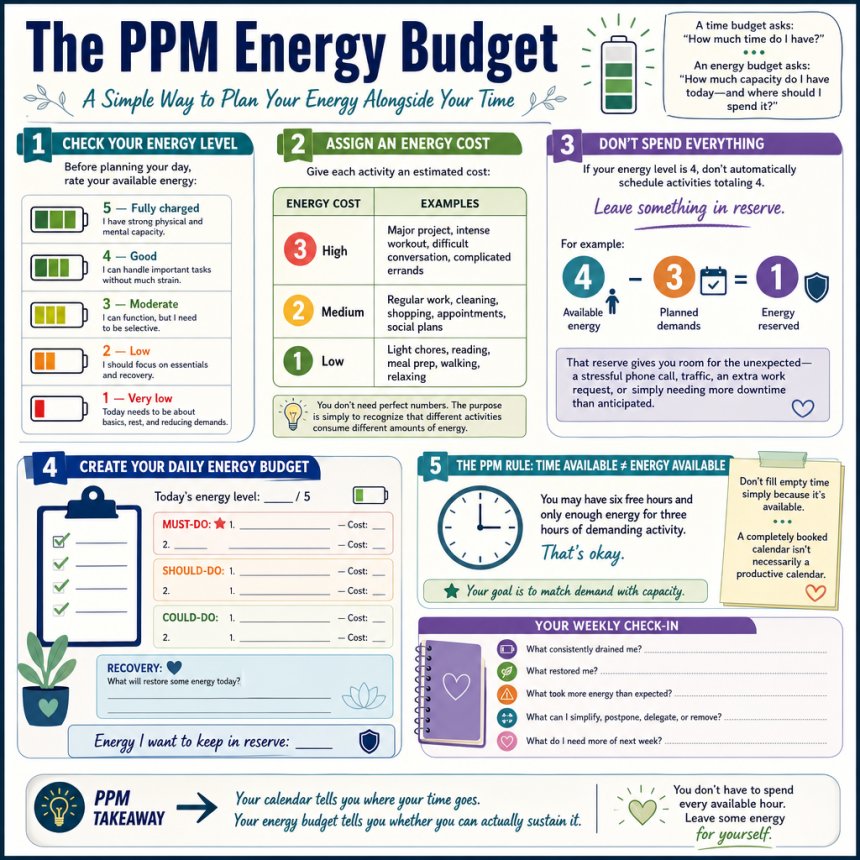
Your calendar tells you where your time goes—but it doesn't always tell you whether you actually have the energy to do everything on it.
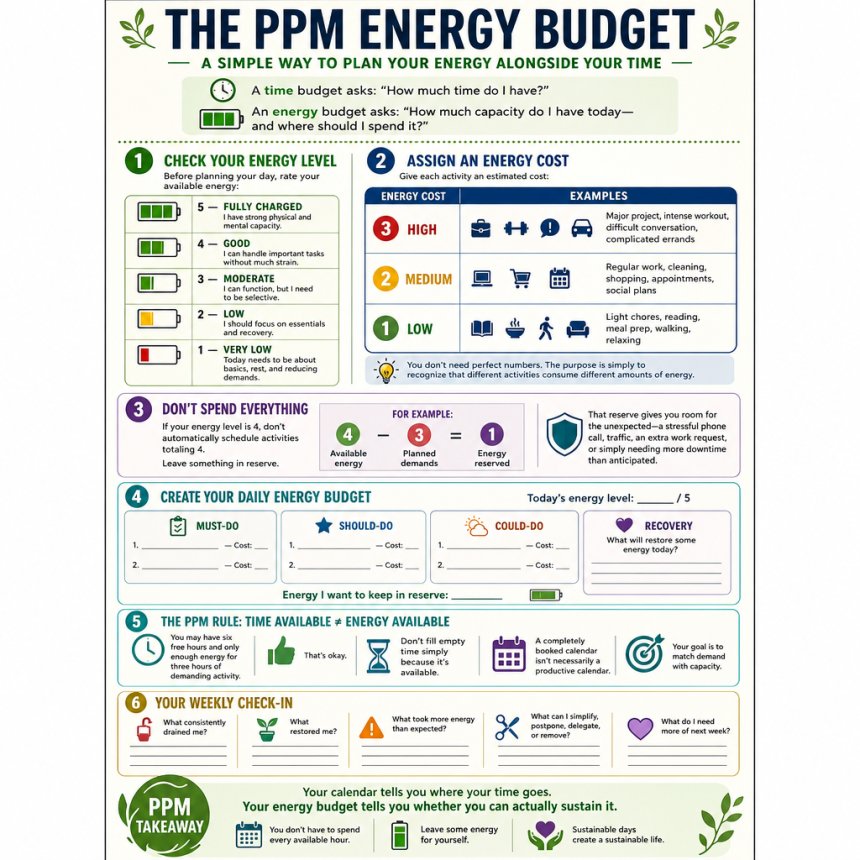
The PPM Energy Budget is a simple planning tool designed to help you understand your daily capacity, identify what drains or restores your energy, and make more realistic decisions about what deserves your attention.
How to Use It
Start by rating your available energy for the day from 1–5. Then, look at your planned activities and give each one an estimated energy cost.
Separate your responsibilities into:
- Must-Do: Essential tasks that need your attention.
- Should-Do: Important tasks that can be completed if your energy allows.
- Could-Do: Optional tasks that can wait.
- Recovery: Time intentionally reserved to recharge.
The goal isn't to spend every point of energy. Leave something in reserve.
At the end of the week, use the reflection section to identify patterns—what consistently drains you, what restores you, and what may need to be simplified or removed.
Why It Benefits You
The PPM Energy Budget can help you:
✔ Plan more realistically instead of treating every hour as equally productive.
✔ Recognize your limits before your schedule becomes overwhelming.
✔ Protect recovery time instead of treating rest as an afterthought.
✔ Prioritize what matters when your energy is limited.
✔ Identify energy drains that may be taking more from you than expected.
✔ Create more sustainable routines that work in real life—not just on paper.
Download the PPM Energy Budget
Don't just ask, “What do I have time for?”
Start asking:
“What do I have the energy for?”
Download the PPM Energy Budget and use it alongside your daily or weekly time budget to build a schedule that respects both your time and your capacity.
Your energy is a resource. Budget it accordingly.
PPM | August 2026 | Health & Wellness
A Message From Our Editorial Team
At PPM, we believe wellness should make your life better—not make you feel like you're failing at it.
This month, we're asking readers to rethink the idea that every hour needs to be optimized, every goal needs to be tracked, and every moment of rest needs to be justified.
Your energy matters just as much as your time.
You can have a completely open schedule and still be exhausted. You can have a productive day and still need to recover. And you can choose to slow down without losing your ambition.
That's why we're introducing the PPM Energy Budget alongside our time-budget approach.
Think of it as a simple reminder to ask yourself:
What do I have the capacity for today—and what deserves that energy?
We're not encouraging readers to do less simply for the sake of doing less. We're encouraging you to become more intentional about what you say yes to, what you postpone, and where you allow yourself to recover.
Because the life you're building requires energy—not just hours on a calendar.
You don't need to maximize every hour. You need enough energy to live the life you're actually building.
— The PPM Editorial Team
Power Pulse Media | August 2026
PPM | Health & Wellness | August 2026
Disclaimer: This article is for general informational and wellness education purposes only. It is not medical advice, diagnosis, or treatment. Individual energy levels, fatigue, exercise needs, and recovery requirements can vary. Consult a qualified healthcare professional for concerns about persistent or unexplained fatigue or other health symptoms.
Share
What's Your Reaction?
 Like
1
Like
1
 Dislike
0
Dislike
0
 Love
1
Love
1
 Funny
0
Funny
0
 Angry
0
Angry
0
 Sad
0
Sad
0
 Wow
1
Wow
1