Technology Fatigue | How to Know When Apps Are Helping—Or Hurting
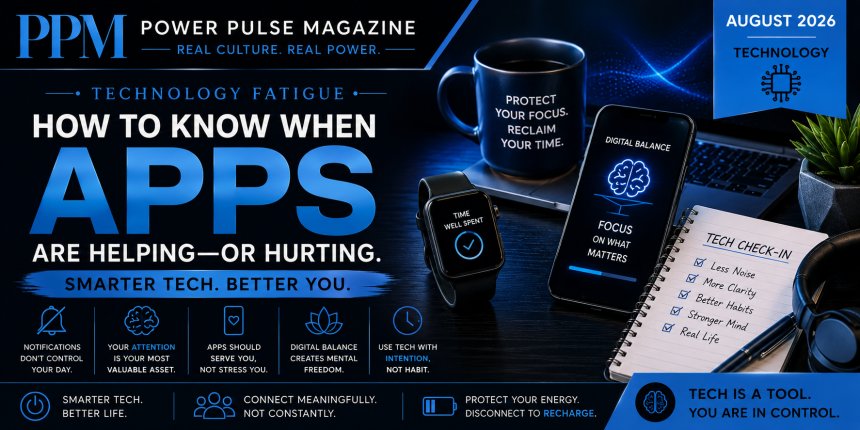

Technology Fatigue
How to Know When Apps Are Helping—Or Hurting
Why Smarter Technology Use Begins with Better Boundaries
By:Todd Deck — Technology Editor & Contributing Writer
Power Pulse Magazine | August 2026
Category: Technology
Editor's Note
Technology has transformed how we work, communicate, shop, learn, and relax. From productivity apps and AI assistants to fitness trackers and smart home devices, digital tools promise to make life easier.
But there's an important question we don't ask often enough:
Is this technology actually helping me—or simply demanding more of my attention?
Technology fatigue isn't about rejecting innovation. It's about recognizing when digital tools stop serving your goals and start competing for your time, focus, and mental energy.
What Is Technology Fatigue?
Technology fatigue is the mental and emotional exhaustion that can develop from constant interaction with digital devices, apps, notifications, and online information.
It doesn't happen overnight.
Instead, it builds gradually through:
- Endless notifications
- Frequent app switching
- Information overload
- Constant connectivity
- Pressure to always respond immediately
Over time, your brain receives fewer opportunities to fully rest.
When Technology Helps
Technology can improve daily life when it's used intentionally.
Examples include:
- Calendar apps that reduce missed appointments
- Budgeting tools that improve financial awareness
- Navigation apps that save time
- Fitness trackers that encourage healthy habits
- Password managers that improve online security
- AI tools that assist with research, organization, and brainstorming
The best technology reduces friction.
It saves time instead of consuming it.
When Technology Starts Hurting
Sometimes the very tools designed to simplify life begin creating new problems.
Common warning signs include:
1. You Feel Busy, But Not Productive
Constantly checking messages, emails, and apps can create the illusion of progress while interrupting meaningful work.
2. You Can't Focus Without Checking Your Phone
If every quiet moment leads to reaching for a screen, your brain may be relying on constant stimulation.
Attention becomes fragmented.
3. Notifications Control Your Day
Every alert competes for your attention.
Many notifications aren't urgent—but your brain still treats them as interruptions.
4. You're Collecting Apps Instead of Solving Problems
Downloading another productivity app won't automatically improve productivity.
Sometimes simplifying your digital tools creates better results than adding new ones.
5. Your Screen Time Keeps Increasing
If your daily screen time surprises you each week, it's worth asking:
Which apps are improving my life—and which are simply filling time?
The Hidden Cost of Constant Connectivity
Many people think fatigue comes from working too much.
Sometimes it comes from never mentally disconnecting.
Work emails after dinner.
Social media before bed.
News alerts throughout the day.
Messages arriving at all hours.
Your brain needs recovery time just like your body does.
Without it, concentration, creativity, and decision-making can suffer.
Conduct Your Own Technology Audit
Choose five apps you use most often.
Ask yourself:
1. Does this app save me time?
2. Does it improve my health or productivity?
3. Does it help me connect meaningfully with others?
4. Would my day be worse without it?
5. Does it frequently distract me from what matters?
If an app creates more stress than value, it may be time to change how—or how often—you use it.
Practical Ways to Reduce Technology Fatigue
You don't have to give up technology.
You simply need healthier boundaries.
Try these habits:
✔ Turn off nonessential notifications.
✔ Create screen-free meals.
✔ Schedule focused work without checking messages.
✔ Keep your phone out of the bedroom if possible.
✔ Review your apps every few months and delete the ones you no longer use.
✔ Use "Do Not Disturb" or Focus Modes during work or personal time.
✔ Replace some scrolling with reading, walking, or conversation.
Small changes can have a meaningful impact on mental clarity.
What Matters Most
Technology should support your goals—not become your goal.
The most valuable apps are the ones that:
- Save you time
- Improve your health
- Strengthen relationships
- Increase financial awareness
- Help you learn new skills
- Reduce unnecessary stress
If a tool consistently leaves you distracted, anxious, or overwhelmed, it deserves another look.
PPM Final Word
Technology isn't the enemy.
Distraction is.
The smartest people in 2026 aren't using every new app that launches. They're choosing digital tools with intention and creating boundaries that protect their attention.
The future isn't about having more technology.
It's about using technology more wisely.
Because your attention is valuable—and the best apps help you protect it, not compete for it.
Why This Matters
Technology is woven into nearly every part of modern life—from work and school to communication, shopping, entertainment, and personal finance. While digital tools can make everyday tasks easier, they can also quietly consume our attention if they're used without intention.
Understanding the difference between helpful technology and technology that creates unnecessary stress empowers you to make smarter decisions about how you spend your time and energy. Developing healthier digital habits can improve focus, reduce mental fatigue, strengthen relationships, and create more space for meaningful work, creativity, and rest.
Why This Article Is Important
This feature encourages readers to look beyond the latest apps and gadgets and instead ask a more valuable question:
"Is this technology improving my life?"
By learning to recognize the signs of technology fatigue, readers can:
- Reduce digital distractions and information overload.
- Improve concentration and productivity.
- Create healthier boundaries between work and personal life.
- Protect their mental well-being in an always-connected world.
- Use technology as a tool rather than feeling controlled by it.
At Power Pulse Magazine, we believe innovation should enhance your life—not overwhelm it. The goal isn't to use less technology; it's to use it more intentionally so it supports your goals, your health, and your overall quality of life.
PPM Editorial Note
Technology should enhance daily life, not overwhelm it. This article is intended for educational purposes and encourages readers to evaluate their digital habits thoughtfully. AI-assisted research supported the editorial process. All content was reviewed and edited by a human editor. Creative direction by Power Pulse Magazine.
Share
What's Your Reaction?
 Like
1
Like
1
 Dislike
0
Dislike
0
 Love
1
Love
1
 Funny
0
Funny
0
 Angry
0
Angry
0
 Sad
0
Sad
0
 Wow
1
Wow
1