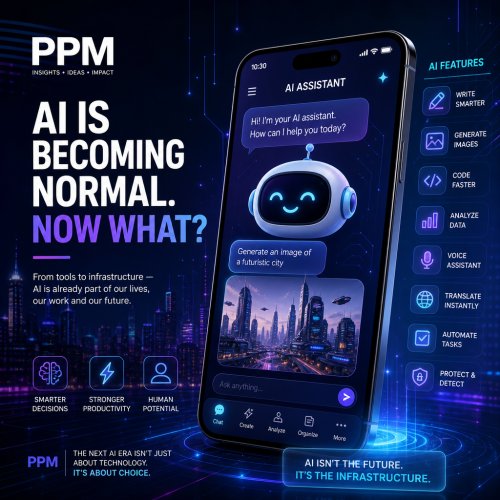
AI Is Becoming Normal. Now What?
AI is no longer a futuristic concept—it’s becoming part of everyday life. From smartphones and shopping to workplaces, businesses, creative agencies and entertainment, AI is changing how people work, create, communicate and make decisions. The next conversation is no longer what AI is, but what happens when AI becomes normal—and how much of our lives we want it to shape. AI is becoming part of everyday life. Explore how AI is transforming consumers, businesses, agencies, work, creativity and the future of technology.



The conversation around AI is shifting from “What is AI?” to “What happens now that AI is simply part of everyday life?”
AI Is Becoming Normal. Now What?
By PPM Editorial
Category: Technology | Business & Finance | Culture
Read Time: 6 min
There was a time when artificial intelligence felt like something from the future.
Now, the future is sitting in our phones.
AI writes emails. It edits photographs. It recommends what we watch. It helps people shop, study, code, plan trips, organize their finances, create presentations, generate music and images, answer questions and even automate parts of a business.
We see AI in search engines, social platforms, customer-service chats, smartphones, cameras, cars, advertising, healthcare, education, banking, entertainment and workplace software.
And increasingly, we don't even notice it.
AI is becoming normal.
So the bigger question for 2026 isn't simply “How advanced is AI?”
It's:
What happens when artificial intelligence stops feeling like a new technology and starts feeling like infrastructure?
AI Has Moved Far Beyond the Chatbot
The first wave of mainstream generative AI introduced people to systems that could produce text, answer questions and generate basic images.
That was only the beginning.
Today's leading AI systems can work across text, images, audio, video, software code and increasingly complex reasoning tasks. Stanford's 2026 AI Index reports that several frontier models now meet or exceed human baselines on areas including advanced science questions, multimodal reasoning and competition mathematics. On one major coding benchmark, performance moved from roughly 60% to near 100% in a single year.
That doesn't mean AI is perfect.
It isn't.
AI can still hallucinate information, misunderstand context, make factual errors, reproduce biases and produce confident answers that are simply wrong.
But the important change is capability.
AI is no longer limited to answering a question.
It can increasingly help complete a task.
That distinction matters.
AI Is Becoming Part of the Consumer Experience
For everyday consumers, AI is increasingly operating behind the scenes.
You may encounter it when:
- Your phone enhances a photograph.
- A streaming service recommends a show.
- A shopping platform predicts what you might want.
- Your email filters spam or suggests a response.
- A navigation app predicts traffic.
- A banking system identifies unusual activity.
- A customer-service chatbot answers a question.
- A search engine summarizes information.
- A social platform recommends content.
- A translation tool converts languages instantly.
- A writing application helps rewrite a sentence.
- A smart device recognizes speech.
- An accessibility tool converts speech to text or describes an image.
Then there are the AI tools people deliberately use.
Someone can now sit down with an AI assistant and say:
“Help me plan my week.”
Or:
“Explain this bill.”
Or:
“Help me understand this job description.”
Or:
“Create a workout plan.”
Or:
“Turn these notes into a presentation.”
The technology has effectively become a general-purpose digital assistant for millions of people.
Stanford estimates that generative AI reached 53% population adoption within three years—faster than the personal computer or the internet—and estimates the annual value U.S. consumers received from generative AI at $172 billion by early 2026.
That is a remarkable transition.
AI isn't just something people are watching develop.
People are using it.
AI for Everyday People: The Personal Productivity Layer
For individuals, AI can function as a kind of personal productivity layer.
It can help someone brainstorm a business idea, organize information, prepare for an interview, learn a new subject, draft correspondence, analyze a spreadsheet or understand complicated material.
For creators, it can accelerate the process of turning an idea into something tangible.
A person with an idea for a children's book, YouTube channel, podcast, newsletter, clothing line or small business can use AI to help move from:
Idea → research → planning → draft → design → marketing → distribution.
That doesn't mean AI replaces the person.
It means the barrier between having an idea and actually doing something with it can become smaller.
And that may be one of AI's most important consumer effects.
AI Inside the Business
Businesses are where the transformation becomes even more significant.
AI is being incorporated into:
- Customer service
Chatbots, automated responses, call-center assistance and customer sentiment analysis.
- Marketing
Campaign concepts, audience research, copywriting, personalization, advertising analysis and content production.
- Sales
Lead qualification, prospect research, sales emails and customer insights.
- Human resources
Recruiting assistance, employee communications, training and workforce analytics.
- Finance
Forecasting, document processing, fraud detection, financial analysis and administrative automation.
- Operations
Scheduling, logistics, inventory management and workflow optimization.
- Technology
Software development, debugging, testing, cybersecurity and technical support.
- Research & development
Data analysis, simulation, scientific research and product development.
This isn't theoretical anymore.
Stanford's 2026 AI Index reports that 88% of surveyed organizations used AI in at least one business function in 2025, while 79% reported regular generative-AI use in at least one business function.
But there is an important reality check.
Adoption doesn't automatically equal transformation.
McKinsey's 2025 research found that while AI use is widespread, many organizations remain in experimentation or pilot stages. Only 39% of respondents reported enterprise-level EBIT impact from generative AI.
In other words:
Businesses are using AI.
They are still figuring out how to use it well.
And Then There Are Agencies
Advertising, marketing, public relations, design, media and creative agencies may be among the industries most visibly transformed by AI.
A traditional agency workflow might involve:
Client brief → research → strategy → copy → design → revisions → presentation → campaign.
AI can now participate in almost every stage.
It can help analyze a brief, research an audience, generate concepts, develop copy variations, create visual directions, organize campaign information, analyze performance and accelerate revisions.
That doesn't necessarily eliminate the agency.
Instead, it changes what the agency sells.
The value increasingly moves away from simply producing assets and toward:
strategy, taste, judgment, brand understanding, creative direction, originality and execution.
That's a major distinction.
If everyone has access to an AI image generator, the image itself becomes less rare.
The idea behind the image becomes more important.
If everyone can generate marketing copy, understanding what should actually be said becomes more valuable.
If everyone can create a video, knowing which video deserves to exist becomes part of the competitive advantage.
AI can produce.
Humans still have to decide what is worth producing.
AI Is Also Changing the Meaning of “Work”
This may be where the conversation gets uncomfortable.
AI isn't only creating new possibilities. It is also changing the economics of certain tasks.
Stanford's 2026 AI Index found that productivity gains are particularly strong in structured, measurable work, with studies reporting gains ranging from 14% in customer support to 26% in software development and 50% in marketing output.
At the same time, the effects on employment are uneven.
Some companies are using AI to increase the output of existing employees.
Others are redesigning jobs.
Some are reducing the amount of human labor required for particular tasks.
And some are creating entirely new AI-related positions.
That means the question probably isn't simply:
“Will AI take everyone's jobs?”
The more useful question is:
“Which parts of our jobs are becoming automated, and which human capabilities are becoming more valuable?”
We Are Already Living in an AI-Assisted World
This is the part that can be easy to miss.
AI doesn't always arrive with a giant announcement.
Sometimes it arrives as a feature.
A button.
A recommendation.
An autocomplete.
A photo enhancement.
A voice assistant.
A search summary.
A customer-service window.
A software update.
A productivity feature.
That's how technology becomes infrastructure.
First, we consciously use it.
Then we use it without thinking about it.
The internet went through the same transformation.
At one point, people talked about “going online.”
Today, being online is simply part of modern life.
AI may be moving toward the same position.
We may eventually stop asking:
“Is this AI?”
And start asking:
“How much AI do we want involved?”
The New Consumer Question: Convenience vs. Control
There is a trade-off emerging.
AI can save time.
But convenience can encourage dependence.
AI can personalize experiences.
But personalization requires data.
AI can help people create.
But generated content raises questions about authenticity, copyright and originality.
AI can improve productivity.
But excessive reliance can weaken human skills.
AI can make information easier to access.
But it can also make misinformation easier to produce.
Stanford's 2026 public-opinion research captures the tension: global respondents increasingly see AI products and services as beneficial, while anxiety about AI is also rising.
That contradiction is probably going to define the next phase of AI.
We can be impressed by it and cautious about it at the same time.
So… What Now?
AI becoming normal doesn't mean the AI story is over.
It means the interesting part may just be beginning.
The first chapter was about proving that AI could do things humans traditionally associated with intelligence.
The next chapter is about integration.
How deeply should AI be incorporated into our workplaces?
1. How much should consumers trust it?
2. What should remain human?
3. What should be automated?
4. Who owns AI-generated work?
5. How should businesses govern it?
6. How should schools teach alongside it?
What happens to entry-level jobs when software can perform tasks that were once used to train beginners?
And perhaps the biggest question:
What do humans do when intelligence becomes increasingly available as a service?
We are going to have to figure that out.
Because AI isn't waiting outside the door anymore.
It's already inside the house.
It's in our phones.
It's in our workplaces.
It's in our entertainment.
It's in our shopping.
It's in our creative tools.
It's in our businesses.
It's in our agencies.
And increasingly, it's woven into the systems we use without ever seeing the word “AI.”
The future of AI may therefore be less about a dramatic moment when machines suddenly take over.
It may be much quieter.
- A feature gets added.
- A workflow changes.
- A job evolves.
- A company restructures.
- A consumer gets used to having an AI assistant.
And eventually, we look around and realize:
AI didn't suddenly become the future.
It became normal.
PPM Summary
The conversation around AI is no longer primarily about what AI is—it's about how deeply it has become integrated into everyday life and what comes next.
AI has moved from an emerging technology into an everyday tool people encounter through search, smartphones, entertainment, shopping, work, customer service, creative platforms and smart devices. In 2026, 36% of U.S. adults say they interact with AI several times a day, while AI is increasingly being used for information, work, creativity, health and everyday problem-solving.
For consumers, AI is becoming a personal assistant and productivity layer. For workers, it can reduce the time needed for routine tasks. The U.S. Census Bureau found that about 55% of workers reported using AI for at least one work task, with many saying it saved them time.
For businesses and agencies, AI is moving beyond experimentation into workflows involving marketing, customer service, finance, research, content creation, software and operations. The next challenge isn't simply adopting AI—it is figuring out how to use it responsibly, effectively and with appropriate human oversight.
And that's where the conversation changes.
AI is becoming normal. Now we have to decide what “normal” should look like.
How much should we automate?
What should remain human?
How much should we trust AI?
What happens to jobs and skills?
Who controls our data?
And how do we make sure convenience doesn't come at the expense of judgment?
The next era of AI isn't necessarily about machines suddenly taking over.
It's about AI quietly becoming part of almost everything we already do—and humans deciding where the line should be.
PPM Takeaway
The goal shouldn't be to blindly embrace AI or fear it.
Learn it. Question it. Use it strategically. Keep your judgment.
AI can be an extraordinary tool—but a tool is only as valuable as the person deciding what to do with it.
The next AI era isn't simply about what machines can do.
It's about what we choose to do with them.
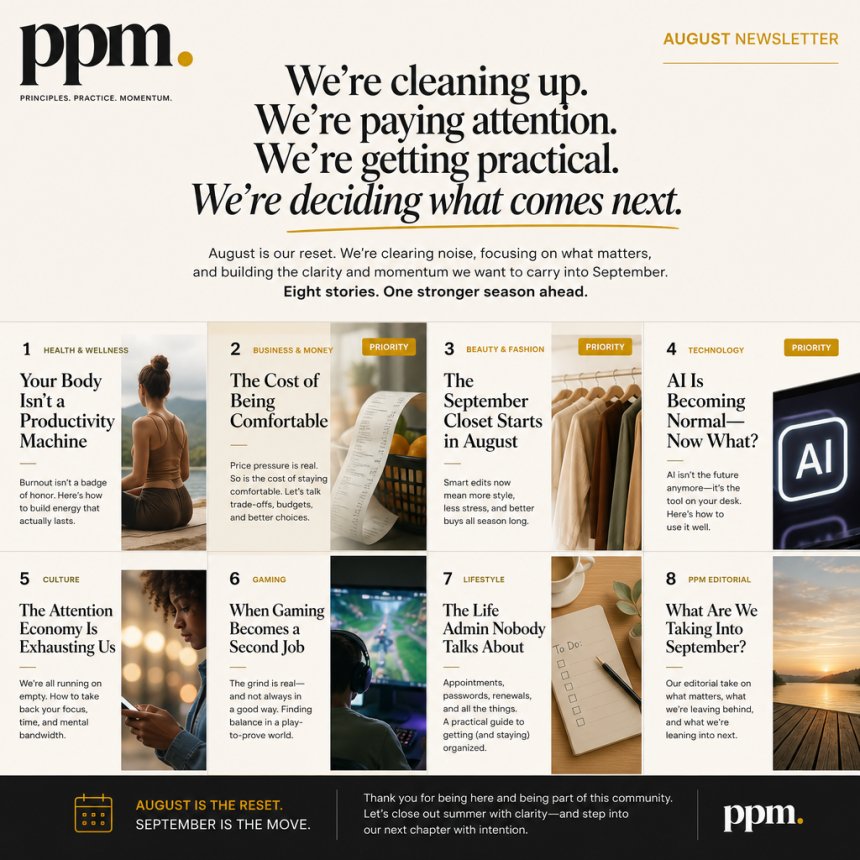
PPM August Newsletter → September
August is our reset. September is the move.
As we close out August, PPM is carrying the lessons, insights, and conversations that matter into our September Digital Issue. This month's stories are about clearing the noise, getting practical, and making intentional choices—across health, money, style, technology, gaming, culture, and everyday life.
The reset doesn't end here. It becomes the foundation for what's next.
Power Pulse Magazine | PPM
Real Culture. Real Power.
PPM Editorial Disclaimer: This article is intended for general informational and editorial purposes. AI technology, capabilities, regulations, products and business applications are developing rapidly. Statistics and industry findings referenced in this article are based on published research available at the time of publication and may change as new data becomes available. AI-generated or AI-assisted outputs should be reviewed by humans for accuracy, context, originality, privacy, security and appropriateness before being relied upon or published. PPM does not present AI as a replacement for professional, legal, financial, medical or other specialized advice.
PPM Universal Editorial Disclaimer:
Disclaimer: Power Pulse Media (PPM) content is provided for informational, editorial, educational, commentary, and entertainment purposes only. PPM makes reasonable efforts to provide accurate, current, and responsibly presented information; however, we do not guarantee that every detail will always be complete, current, or error-free. Information, policies, prices, requirements, opinions, statistics, products, services, and other details may change.
Human Editorial Review: All PPM content is reviewed by a human before publication. PPM may use artificial intelligence (AI) and other digital tools to assist with research, brainstorming, drafting, editing, organization, or content development. AI does not replace human editorial review, judgment, or responsibility. AI-assisted content is reviewed, edited, and approved by a human member of the PPM editorial team before publication.
PPM articles may include original reporting, editorial commentary, analysis, interviews, research, publicly available information, third-party information, and material from external sources. Readers are encouraged to verify important or time-sensitive information through appropriate official or primary sources.
Nothing published by PPM should be interpreted as professional medical, mental-health, legal, financial, investment, tax, insurance, fitness, nutritional, or other specialized advice. When appropriate, readers should consult a qualified professional.
Coverage of individuals, companies, brands, products, entertainment, gaming, technology, media, events, public figures, and other subjects represents PPM's editorial coverage based on information available at the time of publication. Coverage does not automatically indicate endorsement, sponsorship, partnership, or affiliation unless expressly stated.
Some PPM content may include affiliate links, sponsored content, advertisements, promotional material, product features, or brand partnerships. When applicable, such relationships will be disclosed. PPM may receive compensation or commissions from qualifying purchases or partnerships.
All trademarks, logos, photographs, artwork, video, music, names, and other intellectual property referenced or displayed belong to their respective owners unless otherwise stated. PPM does not claim ownership of third-party intellectual property.
Reader discretion is advised. PPM encourages readers to use their own judgment and conduct additional research when making decisions based on information presented in our content.
Power Pulse Media (PPM) — The Pulse.
Share
What's Your Reaction?
 Like
1
Like
1
 Dislike
0
Dislike
0
 Love
0
Love
0
 Funny
0
Funny
0
 Angry
0
Angry
0
 Sad
0
Sad
0
 Wow
0
Wow
0