Fast Cash vs. Passive Assets in 2026


Fast Cash vs. Passive Assets in 2026
Choosing the Right Side Hustle Strategy for Today's Economy
Category: Business | Entrepreneurship | Creator Economy
By: Power Pulse Magazine Staff
Edited by: Todd Deck
Introduction
The side hustle landscape in 2026 looks dramatically different from just a few years ago. Artificial intelligence, automation, rising living costs, and changing work habits have forced entrepreneurs to think strategically about how they earn extra income.
Before starting any side hustle, one important question should be answered:
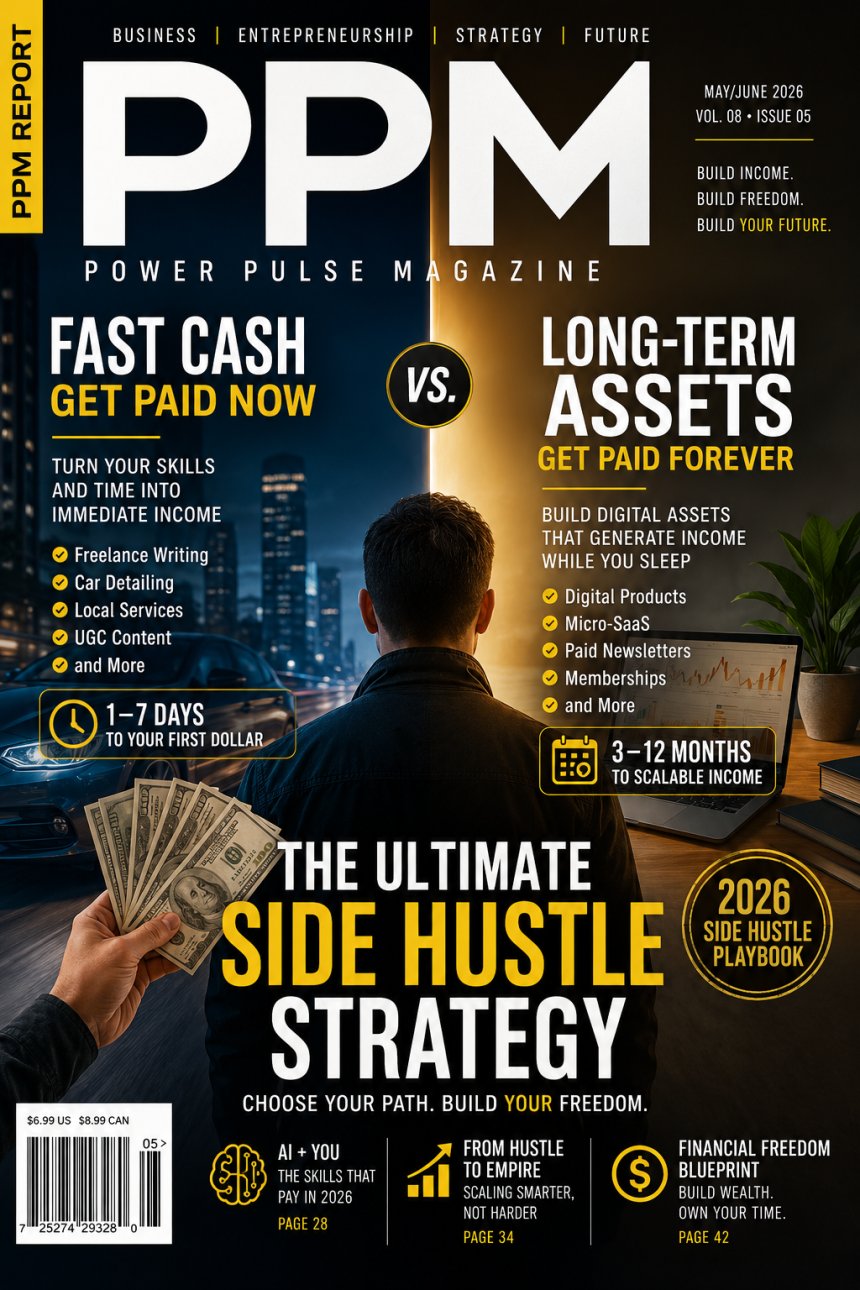
Do you need money quickly, or are you trying to build something that can generate income long after the work is done?
Trying to pursue both approaches simultaneously often leads to burnout and scattered focus because each path requires different systems, timelines, and expectations.
Path One: Fast Cash (Immediate Liquidity)
The fast-cash model exchanges your time, skills, or labor for money right away.
The Formula
Your Time + Skills → Client Payment → Cash Flow
Timeline
- First income: 1–7 days
- Startup cost: $0–$200
- Main advantage: Immediate cash
- Main drawback: Income depends on hours worked
This approach is ideal for:
- Paying off debt
- Covering bills
- Emergency expenses
- Building startup capital
High-Potential Fast Cash Side Hustles in 2026
AI-Assisted Freelance Writing
Businesses continue to outsource:
- Email marketing campaigns
- Product descriptions
- Blog articles
- Landing pages
- Social media content
AI tools help accelerate production, but human editing, creativity, and strategy remain valuable.
Average projects: $50–$500+
Mobile Car Detailing
One of the most overlooked local businesses.
Startup supplies include:
- Microfiber towels
- Vacuum
- Interior cleaner
- Tire shine
- Spray wax
Cleaning two vehicles on a weekend can generate several hundred dollars in revenue.
Why it works:
People increasingly value convenience and at-home services.
Google Business Profile Optimization
Thousands of small businesses still neglect their online presence.
Services may include:
- Updating business hours
- Adding professional photos
- Improving descriptions
- Responding to reviews
- Setting up automated customer responses
Typical one-time fees range from:
$100–$500 per client
UGC Content Creation
Brands increasingly seek everyday creators instead of celebrities.
Creators produce:
- Product videos
- Reviews
- Lifestyle clips
- TikTok and Reels content
Many campaigns pay:
$50–$300+ per video
Path Two: Long-Term Passive Assets
Despite the phrase "passive income," building digital assets requires substantial upfront effort.
The Formula
Initial Work → Build Asset → Automated Sales
Timeline
- 3–12 months
- Startup costs: $50–$500
- Main advantage: Scalability
- Main drawback: Delayed rewards
This model is best suited for entrepreneurs seeking:
- Financial freedom
- Business ownership
- Recurring revenue
- Long-term wealth creation
Scalable Passive Assets Winning in 2026
Digital Templates
Popular products include:
- Notion dashboards
- Budget planners
- Content calendars
- Social media kits
- Small business systems
Platforms:
- Etsy
- Gumroad
- Shopify
Once created, digital products can be sold repeatedly with virtually no inventory costs.
Micro-SaaS Businesses
Small software tools solving one specific problem continue to grow.
Examples:
- Podcast-to-social content automation
- AI email responders
- Lead tracking systems
- Scheduling tools
Many micro-SaaS businesses charge:
$10–$50 per month
The recurring subscription model provides predictable income.
Paid Newsletters
Specialized knowledge has become increasingly valuable.
Popular niches include:
- AI
- Investing
- Fashion trends
- Creator economy news
- Small business resources
Platforms like:
- Substack
- Beehiiv
allow creators to monetize highly targeted audiences.
Membership Communities
People pay for access, information, and networking.
Examples:
- Industry communities
- Coaching groups
- Exclusive newsletters
- Creator memberships
Communities can generate recurring monthly income while fostering loyal audiences.
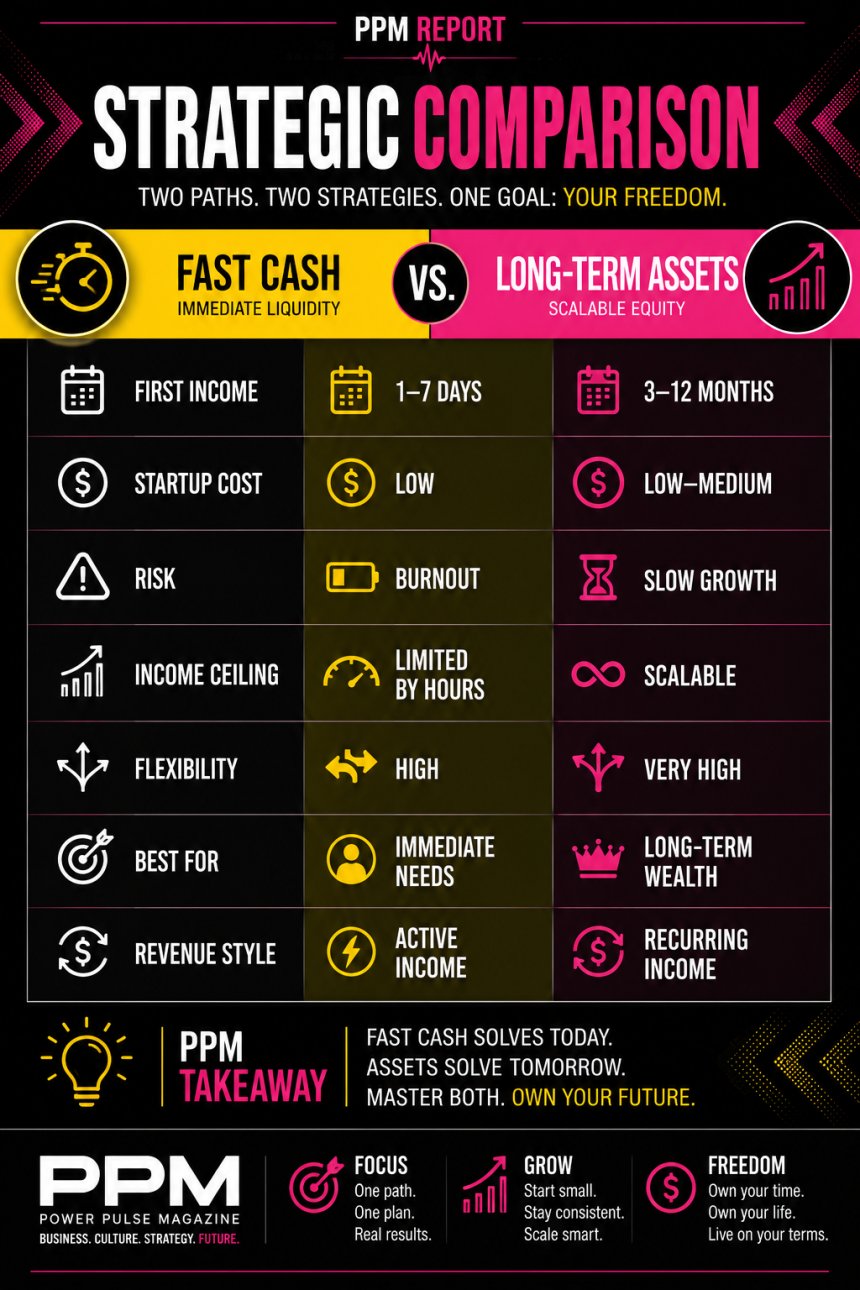
Strategic Comparison
Feature |
Fast Cash |
Long-Term Assets
First Income
1–7 Days
3–12 Months
Startup Cost
Fast Cash: Low
Low-Medium
Risk
Burnout
Slow Growth
Income Ceiling
Limited by Hours
Scalable
Flexibility
High
Very High
Best For
Immediate Needs
Long-Term Wealth
Revenue Style
Active Income
Recurring Income
Understanding the Strategic Comparison
This infographic highlights the fundamental differences between pursuing fast cash and building long-term passive assets. While both can generate income, they operate on completely different timelines and business models.
The Fast Cash path is designed for people who need income quickly. It emphasizes exchanging your time, skills, or labor for immediate payment, often producing results within 1–7 days. Startup costs are typically low, making it accessible to beginners. However, because earnings depend on the number of hours worked, income has a natural ceiling and can eventually lead to burnout if you're constantly trading time for money.
The Long-Term Asset path focuses on creating products or systems that continue generating revenue after the initial work is complete. Although it may take 3–12 months before producing consistent income, digital assets such as templates, online courses, memberships, newsletters, or software can scale far beyond the limitations of hourly work. This approach requires patience and upfront effort but offers significantly greater long-term earning potential.
The chart demonstrates that Fast Cash is ideal for immediate financial needs, while Long-Term Assets are better suited for building lasting wealth and financial independence. Rather than viewing these strategies as competitors, many successful entrepreneurs use them together—earning quick income through active work while reinvesting those profits into scalable assets that can eventually produce recurring income.
PPM Takeaway
Fast cash pays today's bills. Long-term assets build tomorrow's wealth. The strongest business strategy isn't choosing one over the other—it's knowing when to use each as your financial goals evolve.
The Hybrid Strategy
Many successful entrepreneurs in 2026 combine both models.
Stage 1
Use fast-cash side hustles to create immediate income.
Examples:
Freelancing
Car detailing
Content creation
Local services
↓
Stage 2
Reinvest profits into building assets.
Examples:
Digital products
Websites
Membership communities
Micro-SaaS businesses
Paid newsletters
↓
Stage 3
Transition from trading hours for money to owning systems that generate recurring revenue.
PPM Report
The biggest myth about side hustles in 2026 is that passive income is effortless.
In reality, today's most successful entrepreneurs build systems first and freedom later.
Fast cash solves today's problems.
Assets solve tomorrow's.
The smartest builders understand that you don't necessarily have to choose one forever—you simply need to know which season of business you're currently in.
PPM Takeaway
Need money now? Build liquidity.
Want wealth later? Build assets.
Master both, and you'll eventually own your time instead of selling it.
Editor's Note
The side hustle economy evolves rapidly. Earnings vary depending on experience, market demand, location, and execution. Power Pulse Magazine encourages readers to research opportunities thoroughly and understand that building sustainable income—whether active or passive—requires consistency, patience, and realistic expectations.
Edited by: Todd Deck
Sources
Information synthesized from industry reporting, creator economy trends, small-business studies, and publicly available research from financial and entrepreneurship publications including Charles Schwab Asset Management, MoneyLion, Amasty, Jiraaf, Coachli, and other business resources. Earnings examples are illustrative and may vary by market and individual performance.
PPM Disclaimer
This article is published by Power Pulse Magazine (PPM) for informational and educational purposes only. It should not be considered financial, investment, tax, legal, or business advice. Any income examples, earnings, timelines, or business opportunities discussed are estimates based on publicly available industry information and may not reflect individual results.
Side hustle success depends on numerous factors, including experience, market demand, pricing strategy, consistency, location, competition, and execution. Readers should conduct their own research and consult qualified financial, tax, or legal professionals before making business or investment decisions.
This feature was researched using publicly available sources and AI-assisted editorial tools. All content has been reviewed, fact-checked, and edited by a human editor in accordance with Power Pulse Magazine's editorial standards. Creative direction, editorial oversight, and final publication decisions are the responsibility of Power Pulse Magazine.
© 2026 Power Pulse Magazine. All rights reserved.
Share
What's Your Reaction?
 Like
1
Like
1
 Dislike
0
Dislike
0
 Love
0
Love
0
 Funny
0
Funny
0
 Angry
0
Angry
0
 Sad
0
Sad
0
 Wow
0
Wow
0