The Cost of Being Comfortable How Lifestyle Inflation Quietly Changes Your Financial Life
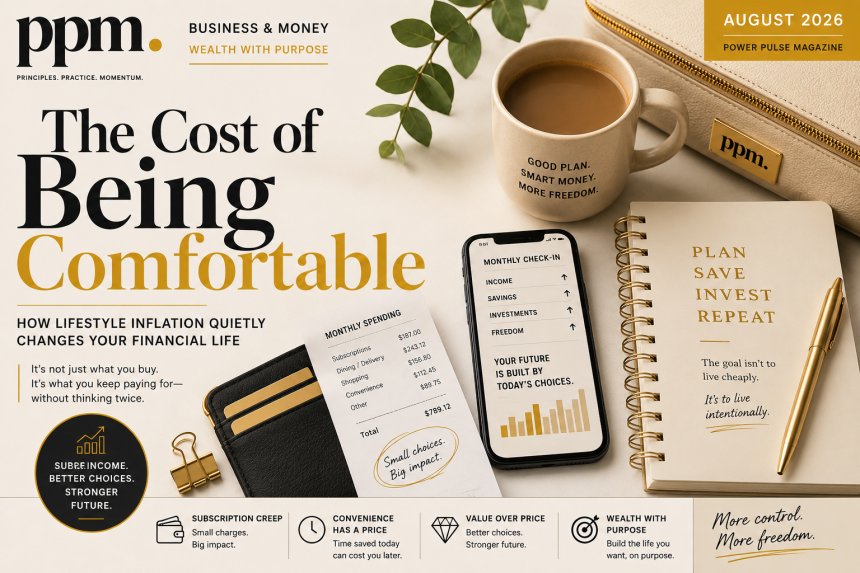
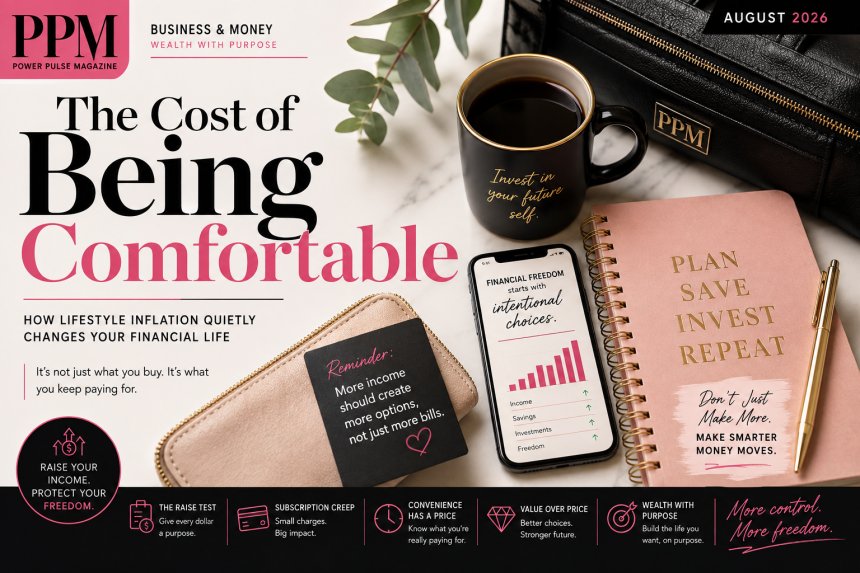
The Cost of Being Comfortable
How Lifestyle Inflation Quietly Changes Your Financial Life
By: Maya Brooks — Lifestyle & Wellness Writer
Power Pulse Magazine | August 2026
Category: Business & Money
PPM Focus: Wealth With Purpose
The Raise Arrived. So Did the Bills.
There is a financial trap that doesn't always feel like a trap.
You get a raise.
You finally have a little breathing room.
You upgrade your phone. Move into a nicer apartment. Add another streaming service. Order delivery a little more often. Upgrade your car. Start paying for convenience instead of doing things yourself.
None of these decisions seems outrageous individually.
Then one day you look at your bank account and realize:
Your income increased—but your financial freedom didn't.
That's lifestyle inflation.
And in 2026, it deserves a more realistic conversation.
The 2026 Reality: Higher Prices Change the Baseline
It's important not to confuse lifestyle inflation with ordinary inflation.
Sometimes your spending increases because things genuinely cost more.
The latest U.S. data show why simply telling households to "spend less" misses the point. The Federal Reserve's preferred PCE price index rose 3.7% year over year in July 2026, while core PCE increased 3.3%. Consumer spending increased just 0.2% in July, down from 0.3% in June.
In other words, households are dealing with an environment where prices remain elevated while spending growth has begun to moderate.
That creates an important distinction:
Not every increase in your budget is lifestyle inflation.
If your grocery bill rises because food costs more, that's inflation.
If your rent increases, that's a higher housing cost.
If your insurance premium changes, that's an unavoidable budget adjustment.
But if your income rises and you voluntarily add three new recurring expenses because you can now "afford them," that's lifestyle inflation.
Knowing the difference matters.
What Lifestyle Inflation Actually Looks Like
Lifestyle inflation isn't necessarily buying a yacht after getting a promotion.
It's usually much quieter.
Before the raise:
You make coffee at home.
After the raise:
You buy coffee on the way to work three times a week.
Before:
You have one streaming service.
After:
You subscribe to five because each one seems inexpensive.
Before:
You repair something.
After:
You replace it immediately because convenience feels worth the money.
Before:
You have a modest car payment.
After:
You decide your new income means you can handle a significantly larger payment.
None of these decisions automatically makes you irresponsible.
The problem is when every increase in income becomes an excuse to increase fixed expenses.
The Most Dangerous Upgrades Are the Recurring Ones
A $40 purchase is one thing.
A new $40 monthly obligation is different.
That's because recurring expenses don't ask for your attention every month.
They simply withdraw the money.
Consider:
- $15 streaming subscription
- $12 premium app
- $20 membership
- $35 upgraded phone plan
- $45 meal-delivery service
- $60 convenience service
Individually, they don't look dramatic.
Together, that's $187 every month—or $2,244 a year.
And that's before taxes, price increases, or additional purchases.
PPM Insight
When evaluating a new expense, don't ask only:
"Can I afford $40?"
Ask:
"Do I want another $480 annual commitment?"
That question changes the conversation.
Subscription Creep Is Lifestyle Inflation in Disguise
Subscriptions are particularly easy to accumulate because they feel small.
A service might cost $8, $12, or $20.
But the modern household can have subscriptions for almost everything:
Entertainment.
Cloud storage.
Fitness.
Food delivery.
Shopping.
Gaming.
Productivity.
News.
AI tools.
Beauty boxes.
Music.
The problem isn't subscriptions themselves.
The problem is paying for services you've stopped valuing.
Try this:
Open your bank or credit-card statement and search for every recurring charge.
Mark each:
- KEEP
- QUESTION
- CANCEL
- RENEGOTIATE
You may discover that your biggest financial leak isn't one massive purchase.
It's dozens of tiny decisions you stopped noticing.
Convenience Has a Price
Convenience is one of the most understandable forms of lifestyle inflation.
When you're exhausted, paying for delivery makes sense.
When you're busy, paying someone else to handle a task may be worthwhile.
When you're earning more, buying back some of your time can actually be a rational financial decision.
The question is whether you're purchasing intentional convenience or simply spending because you're tired of making decisions.
Ask:
"Is this purchase buying back meaningful time—or just avoiding five minutes of effort?"
That's a powerful distinction.
Expensive Doesn't Always Mean Valuable
One of the biggest financial mistakes is assuming that a higher price automatically means a better life.
It doesn't.
A $1,000 purchase can be wasteful.
A $1,000 purchase can also be an excellent investment in your work, health, education, or quality of life.
The price isn't the whole story.
Think in terms of value per use.
A $300 coat worn 100 times may provide more practical value than a $100 coat worn twice.
A quality computer used for work every day may be more valuable than multiple inexpensive gadgets.
A professional certification that increases earning potential can have a completely different financial impact from an impulse purchase.
PPM rule: Price tells you what something costs. Value tells you what it does for you.
The Raise Test
The next time your income increases, don't immediately redesign your entire lifestyle.
Instead, divide the additional income into three questions:
1. What genuinely needs more money?
Maybe your groceries, transportation, healthcare, or housing costs have increased.
Adjust for reality.
2. What would meaningfully improve my life?
Choose improvements deliberately.
Maybe it's a better mattress.
Maybe it's a vacation.
Maybe it's paying for a service that gives you back several hours every month.
3. What should become future money?
Consider directing part of the increase toward:
- Emergency savings
- Retirement
- Investments
- Debt reduction
- A future purchase
- A financial buffer
The goal isn't to deny yourself the benefits of earning more.
It's to give the raise more than one job.
The Lifestyle Inflation Audit
KEEP
Expenses that genuinely improve your life or support your priorities.
Examples:
Reliable transportation
Necessary insurance
Useful professional tools
Health-related expenses
Experiences you genuinely value
QUESTION
Expenses that feel normal but aren't necessarily valuable.
Examples:
Unused memberships
Multiple overlapping apps
Frequent delivery
Automatic upgrades
Impulse purchases
CUT
Expenses that provide little value relative to their cost.
Ask:
"If this disappeared tomorrow, would I actually miss it?"
If the answer is no, investigate further.
UPGRADE INTENTIONALLY
Spend more when the additional cost produces meaningful value.
Think:
Better—not simply more.
A Simple Rule for Raises
Consider creating a personal raise rule.
For example:
| When my income increases, I will improve my lifestyle with part of the increase and automatically direct another portion toward my financial future.
The exact percentage should depend on your circumstances.
There is no universal formula that works for everyone.
Someone paying down high-interest debt has different priorities from someone with substantial emergency savings.
The important part is making the decision before the extra money becomes invisible.
Don't Budget Against an Imaginary Economy
This is especially important in 2026.
A budget created years ago may no longer reflect your actual costs.
- Your rent may be different.
- Insurance may be higher.
- Groceries may cost more.
- Utilities may have changed.
- Services may have raised prices.
- Your income may have changed too.
That's why the goal isn't to return your spending to some arbitrary number from five years ago.
Build your financial plan around today's reality.
Then decide which expenses are necessary, valuable, optional, or simply habitual.
The Real Goal Isn't Living Cheap
This deserves emphasis.
Financial discipline does not mean refusing every nice thing.
It doesn't mean never eating at restaurants.
It doesn't mean wearing old clothes forever.
It doesn't mean living as though your income never increased.
That's deprivation—not necessarily financial strategy.
The goal is intentional expansion.
When your financial capacity grows, let your lifestyle improve.
Just don't allow every improvement to become a permanent obligation.
PPM's Three-Question Money Check
Before adding a new recurring expense, ask:
1. Will this improve my life six months from now?
2. Would I still want it if nobody else knew I had it?
3. Is this purchase improving my life—or simply increasing my monthly obligations?
If you can answer those honestly, you're already thinking differently.
Why This Matters Right Now
The current economy makes this conversation more complicated than the classic advice to "stop buying coffee."
Consumers are already adjusting.
Recent data show July spending growth slowed, while inflation remained well above the Federal Reserve's 2% target.
That means financial resilience isn't simply about cutting everything.
It's about understanding which increases in spending are unavoidable and which ones are choices.
That's the real power of a modern budget.
Not punishment.
Prioritization.
PPM Takeaway
You don't need to live like you're broke to avoid lifestyle inflation.
You need to know where your money is going—and decide whether the life you're paying for is actually the life you want.
When your income increases, don't automatically increase everything else.
Let some of the extra money create:
- More security.
- More options.
- More flexibility.
- More freedom.
Because the ultimate goal of earning more isn't simply to afford more.
It's to have more control over your life.
PPM Tool: The Lifestyle Inflation Audit
This month, review your last 30 days of spending.
Expense | Keep | Question | Cut | Upgrade Intentionally
Housing ☐ ☐ ☐ ☐
Subscriptions ☐ ☐ ☐ ☐
Dining/Delivery ☐ ☐ ☐ ☐
Transportation ☐ ☐ ☐ ☐
Shopping ☐ ☐ ☐ ☐
Entertainment ☐ ☐ ☐ ☐
Convenience Services ☐ ☐ ☐ ☐
Personal Care ☐ ☐ ☐ ☐
My One Adjustment
I will change: __________________________
Estimated monthly impact: $____________
What I'll do with the difference: __________________________
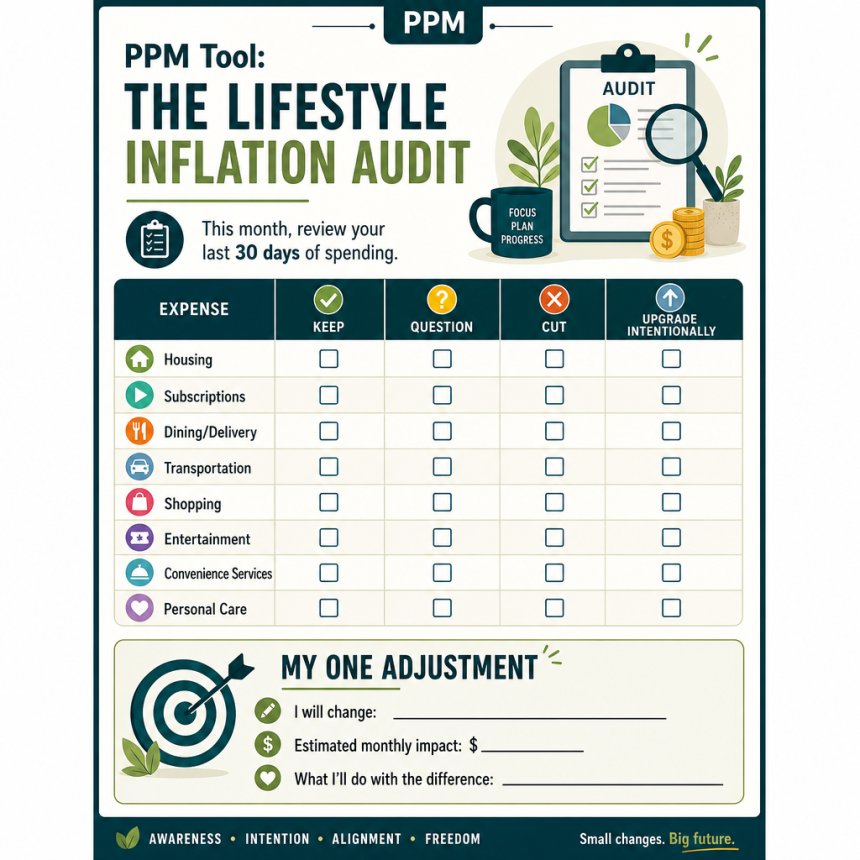
PPM Lifestyle Inflation Audit
A 30-Day Spending Check-In for More Intentional Money Decisions
Your income may change, but that doesn't mean every expense needs to grow with it. The PPM Lifestyle Inflation Audit helps you take a realistic look at where your money is going and identify the expenses that are adding value, becoming habits, or quietly increasing your monthly obligations.
Review your last 30 days of spending and sort each area into Keep, Question, Cut, or Upgrade Intentionally. Then choose one realistic adjustment and decide what you'll do with the money you free up.
Inside the printable:
8 major spending categories
Keep / Question / Cut / Upgrade Intentionally checklist
One Adjustment planning section
Estimated monthly savings field
Space to decide where the difference will go
PPM Money Check for intentional spending
Perfect for: readers experiencing lifestyle inflation, rising living costs, subscription creep, or simply wanting more control over their money without adopting an overly complicated budget.
PPM Perspective:
The goal isn't to live cheaply. It's to make sure your lifestyle doesn't consume every improvement in your income.
Download. Print it. Review your spending. Make one better decision at a time.
PPM Final Thought
Don't make your lifestyle so expensive that your success becomes another financial pressure.
Earn more. Live well. Keep your options.
Power Pulse Magazine | August 2026
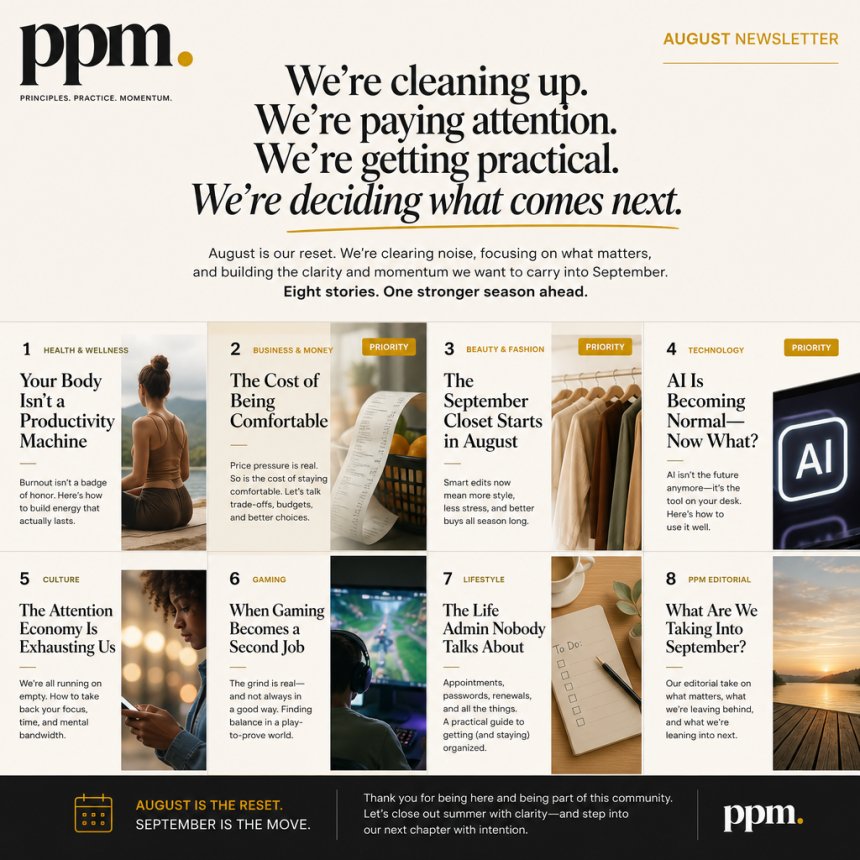
PPM August Newsletter → September
August is our reset. September is the move.
As we close out August, PPM is carrying the lessons, insights, and conversations that matter into our September Digital Issue. This month's stories are about clearing the noise, getting practical, and making intentional choices—across health, money, style, technology, gaming, culture, and everyday life.
The reset doesn't end here. It becomes the foundation for what's next.
We’re Cleaning Up.
We’re paying attention.
We’re getting practical.
We’re deciding what comes next.
August is our reset. September is the move.
We’re clearing the noise, taking a closer look at what matters, and making room for better choices. From health and wellness to money, beauty, fashion, technology, gaming, culture, and everyday life, PPM is focusing on stories that meet readers where they are—and help them move forward with intention.
Eight stories. One stronger season ahead.
Power Pulse Magazine | PPM
Real Culture. Real Power.
Financial disclaimer: This article is for general educational purposes and is not individualized financial, investment, tax, or legal advice. Personal circumstances vary, particularly regarding debt, housing, income, taxes, and investing. Readers should consult a qualified professional for advice specific to their situation.
Share
What's Your Reaction?
 Like
0
Like
0
 Dislike
0
Dislike
0
 Love
0
Love
0
 Funny
0
Funny
0
 Angry
0
Angry
0
 Sad
0
Sad
0
 Wow
0
Wow
0